Delicious Open Fire Cooked Cajun Stuffed Beef Tenderloin
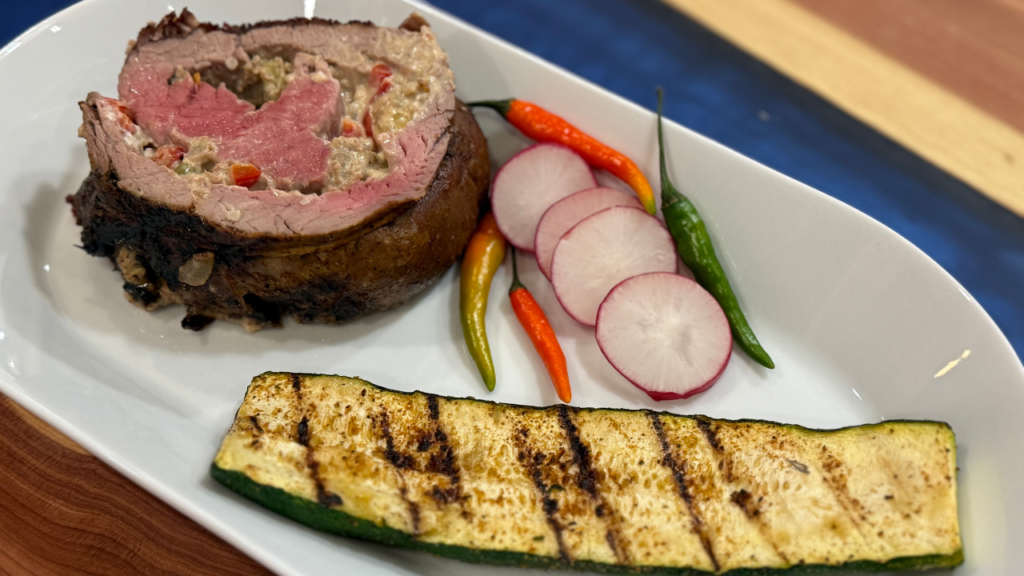
The stuffing we made for the Smoked Gator recipe was so darned good, we knew Cajun Stuffed Beef Tenderloin would be a winner!
Things to know:
What is Cajun food?
Cajun food is a rustic, flavorful Louisiana cuisine originating from Acadian immigrants, characterized by hearty one-pot meals, bold spices, and the “holy trinity” of celery, bell peppers, and onions. Key dishes include gumbo, jambalaya, étouffée, boudin sausage, and crawfish boils, often featuring seafood, smoked meats, and rice.
What are the origins of Cajun cuisine?
Cajun cuisine originated from French settlers (Acadians) exiled from Canada in the 18th century who settled in rural southern Louisiana, merging rural French cooking with local ingredients. This “peasant” style food adapted to bayou surroundings, relying on,,,”the Holy Trinity” (onion, celery, bell pepper), seafood, wild game, and one-pot methods like gumbo.
What is the signature dish of Louisiana?
Gumbo is the premier signature dish of Louisiana, a hearty stew representing both Creole and Cajun traditions. It is officially recognized as the state cuisine. Other iconic Louisiana dishes include jambalaya, étouffée, po’boys, and crawfish boils.
What is the difference between Cajun food and Creole food?
Creole food is considered “city food” (New Orleans), featuring tomatoes, butter, and herbs, reflecting European, African, and Caribbean influences. Cajun food is “country food” (bayou), focusing on rustic, one-pot meals, dark roux, pork, and intense spice. Creole is richer and more varied, while Cajun is spicier and earthier.
How do you know if you’re Creole or Cajun?
Cajuns are descendants of French-speaking Acadian exiles (from Canada) who settled in rural South Louisiana, focusing on rustic, meat-focused cuisine. Creoles have more diverse roots—blending French, Spanish, African, and Native American heritage—primarily in urban New Orleans. Cajuns are often considered a subset of the larger Louisiana Creole culture.
Ingredients:
1 5ish lb beef tenderloin
1/2 lb boudin, removed from casing
8 oz cream cheese at room temperature
1 celery stalk, finely diced
1/2 red bell pepper, finely diced
1/4 sweet onion, finely diced
2 T butter
1 T minced garlic
1/2 cup shredded pepper jack cheese
1 T your favorite Cajun seasoning
Salt, pepper and more of your favorite seasoning to season the outside of the tenderloin
1. Lay the beef tenderloin on a cutting board perpendicular to yourself. Yes, I know you do not often see that word in a recipe…
2. Cut about an inch deep slit about 1/4 of the way up on the tenderloin for the length of the tenderloin. (This is hard to describe in words…see the video if this does not make sense. Also watch it if this does make sense because the views help the channel…)
3. Roll the remainder of the tenderloin away from the cut and cut again about an inch deep. You will continue this until you have a “meat sheet” in front of you. Set this aside and get to work on the stuffing.
4. In a medium sized skillet, melt the butter on medium high heat, then add the Holy Trinity (onion, celery, peppers) and the boudin. Cook until the boudin is done, then set aside to cool.
5. In a large bowl, combine the boudin/Holy Trinity mixture, cream cheese, pepper jack cheese and Cajun seasoning.
6. Spread the stuffing evenly over the “meat sheet”, keeping away from the edges by about 1/2”.
7. Roll the “meat sheet” up and tie off to form a glorious tube of wonderfulness.
8. Season the outside of the “meat tube of wonderfulness” with salt, pepper and your favorite Cajun seasoning.
9. Place on your grill in a spot where you can hold your have over the cooking area for only 8-10 seconds before the heat makes you pull your hand away.
10. Grill the tenderloin until the temp gets to about 110F, then move to a hotter part of the grill to sear the outside.
11. Remove from the grill and allow to rest for about 15 minutes. Then cut into rounds, serve and ENJOY!
Equipment used:
Shogun Series Chef’s Knife 10.25”
Gladiator Series Chef & Utility Knife 7”
DISCLOSURE: When we link to products and services, those links may be customized affiliate links. If you click on any of those affiliate links and make a purchase within a certain time frame, We’ll earn a small commission. The commission is paid by the retailers.
Here’s an example: If we link to our favorite vegetable peeler, and you click on that link and complete a purchase within the next 24 hours, we may receive a commission somewhere between 1 to 10 percent of your total order.
We are careful to link to products and retailers that we use ourselves and recommend. These affiliate programs use cookies to track visits for the purposes of assigning commission on these sales. Money earned keeps Galley of the Sun running and allows us to do what we love.
Thank you for your support.
SELECT AFFILIATE PROGRAM DETAILS: We are currently members of affiliate programs with Amazon and Dalstrong. We are eligible to earn from qualifying purchases.